
English| EUR
Suggested for you
More currencies
Choose a language
Most newcomers assume the sport rewards strength. It rewards repetition, a fixed stance and a consistent release, which is why coached lanes exist at all. This axe throwing how to play guide sets out the format of a session, how points are counted, and how a group moves through a lane without downtime.
Quick answer
A standard session runs 60 minutes and costs 25 EUR per person, covering instruction, lane time and scored rounds. Throwers alternate at a marked line, aiming at a wooden target divided into scoring rings, with a bullseye at the centre and higher-value clutch zones at the upper corners. Groups rotate so each person throws, retrieves and scores in turn.
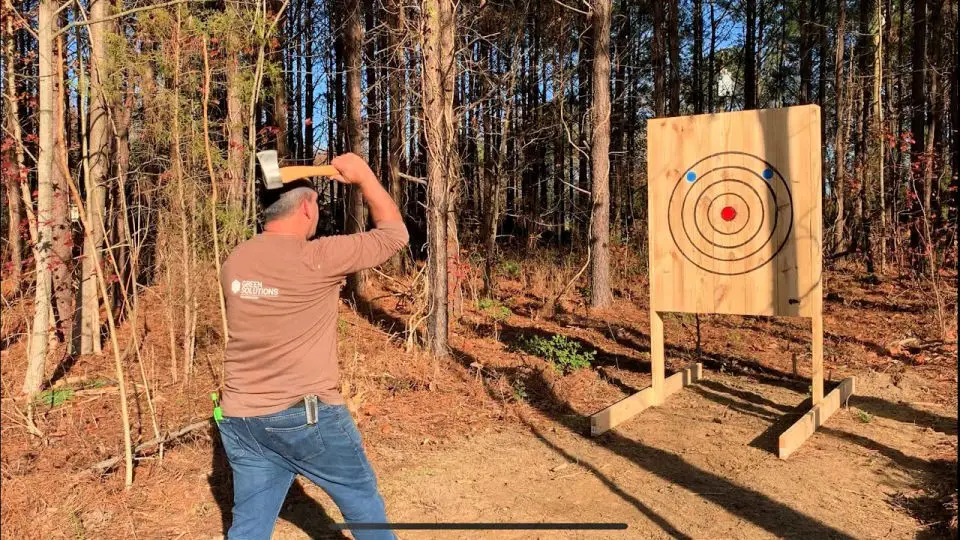
The target used in competitive throwing is not a dartboard in disguise. It is a block of soft end-grain wood, usually pine or poplar, that splits along the fibre to accept the blade rather than bouncing it back. That single material choice explains most of the sport's conventions: the grain runs vertically, the rings are painted on after the boards are assembled, and the boards are replaced once the centre becomes too chewed to hold an edge. Anyone researching axe throwing how to play will meet this detail early, because the wood dictates the angle of the throw. A lane is a corridor, not a booth. It is bounded by a throwing line, a run-up area behind it, and side barriers that keep neighbouring throwers out of each other's arc. One person throws at a time. The rest of the group stands behind the line, which is why a coached group of six moves faster than a group of two trying to improvise. Instructors set the stance first — square shoulders, dominant foot forward, elbow high — then adjust distance, since a single pace forward or back is usually what separates a blade that sticks from one that rotates too far. Hatchets are light, typically under two kilograms, and the grip is loose rather than clenched. Scoring follows the same logic in most venues: concentric rings worth more toward the centre, with small clutch targets at the top corners reserved for the final throw of a round. Matches are played as sets of throws rather than a running clock, so a group learns the rhythm of throw, call the score, retrieve, reset. Closed-toe shoes and clothing that allows a full overhead swing matter more than any equipment the thrower brings. For planning purposes, the practical questions are when to come and how long to allow. Weekend afternoons give instructors more time per thrower than peak evenings, and the recommended arrival window of 12:00–20:00 reflects that. Venues operate as a worldwide network of local branches rather than a single site, so the official operator page lists the address for a given city — useful for anyone combining a session with other Kraków activities. Reading an axe throwing rules and scoring guide beforehand shortens the briefing, but nothing replaces the first dozen throws. This axe throwing how to play guide is a frame; the dedicated sections below carry the hours, the step-by-step technique and the lane safety rules in full.
“The wood dictates the angle of the throw — grain runs vertically, and the blade is meant to split it, not bounce off it.”
These six steps take you from the throwing line to a finished match, covering stance, grip, release, and how points are counted. A standard 60-minute session leaves room to learn the technique and still play a few scored rounds.
Your coach demonstrates the throwing lane, the fault line you cannot cross, and the signal for retrieving axes. Most beginners tune out the retrieval rules and walk forward while a neighbour is still mid-throw.
Stand square to the target with feet shoulder-width apart, dominant foot slightly back, roughly four to five metres from the board. People crowd too close, which makes the axe hit handle-first before the blade has finished rotating.
Hold the base of the handle with both hands stacked, thumbs flat along the back, firm but relaxed. A white-knuckle grip is the single most common fault because it kills the release and sends the axe low.
Bring the axe straight back over your head, keep elbows tracking forward, and release as your arms reach eye level in one smooth motion. Avoid flicking your wrists or bending your elbows out sideways, which adds spin and tilts the blade.
Blade too high on the board means step back half a pace; handle hitting first means step forward. Adjust distance rather than changing your arm motion, which is what makes most people inconsistent.
The bullseye counts five, the next ring three, the outer ring one, and the small clutch dots at the top corners count six but only when called before throwing. A blade must stay stuck in the wood to count, so an axe that drops after sticking scores nothing.
Axe Throwing is open Tuesday through Sunday, with extended operating hours during the weekend. The facility remains closed on Mondays.
Axe throwing lanes work on strict safety discipline: one thrower, one lane, one axe in motion at a time. Instructors enforce these rules, and ignoring them ends a session early.
Prepare these essentials before your axe throwing session to ensure a smooth arrival and safe experience.
Everything you need to know about axe throwing how to play
To master axe throwing how to play, start by focusing on your stance, grip, and follow-through. Most beginners find success by keeping their arm straight and releasing the handle when it is level with their shoulder. Practicing your target aim and learning to read the wooden lane surface will improve your accuracy over time.
Each standard axe throwing how to play session lasts for 60 minutes. This duration allows enough time for a safety briefing, technique coaching, and multiple rounds of competitive throwing. Longer durations can be arranged depending on group size and availability.
Yes, safety is the top priority during every axe throwing how to play event. Always remain behind the safety line until it is your turn and never retrieve an axe while others are still throwing. Following the instructions of the lane marshal ensures a secure environment for all participants.
Qualified instructors are on-site to assist with your axe throwing how to play technique. They provide essential tips on handle grip, rotation control, and how to safely lodge the blade into the target. Their expertise helps players of all skill levels improve quickly.
The entry fee for a 60-minute session is 25 EUR per person. This standard price covers the use of the throwing lanes, rental of the equipment, and professional coaching. Please check the booking portal for availability before planning your visit.
Age restrictions vary by location, so it is recommended to verify the specific policies of your branch before booking an axe throwing how to play session. Safety regulations often require minors to be accompanied by an adult. Always consult the operator's official guidelines regarding age limits and equipment handling.
The best arrival window is between 12:00 and 20:00 to avoid peak weekend crowds. Visiting during these hours helps ensure better instructor availability and a more relaxed environment for your practice session.